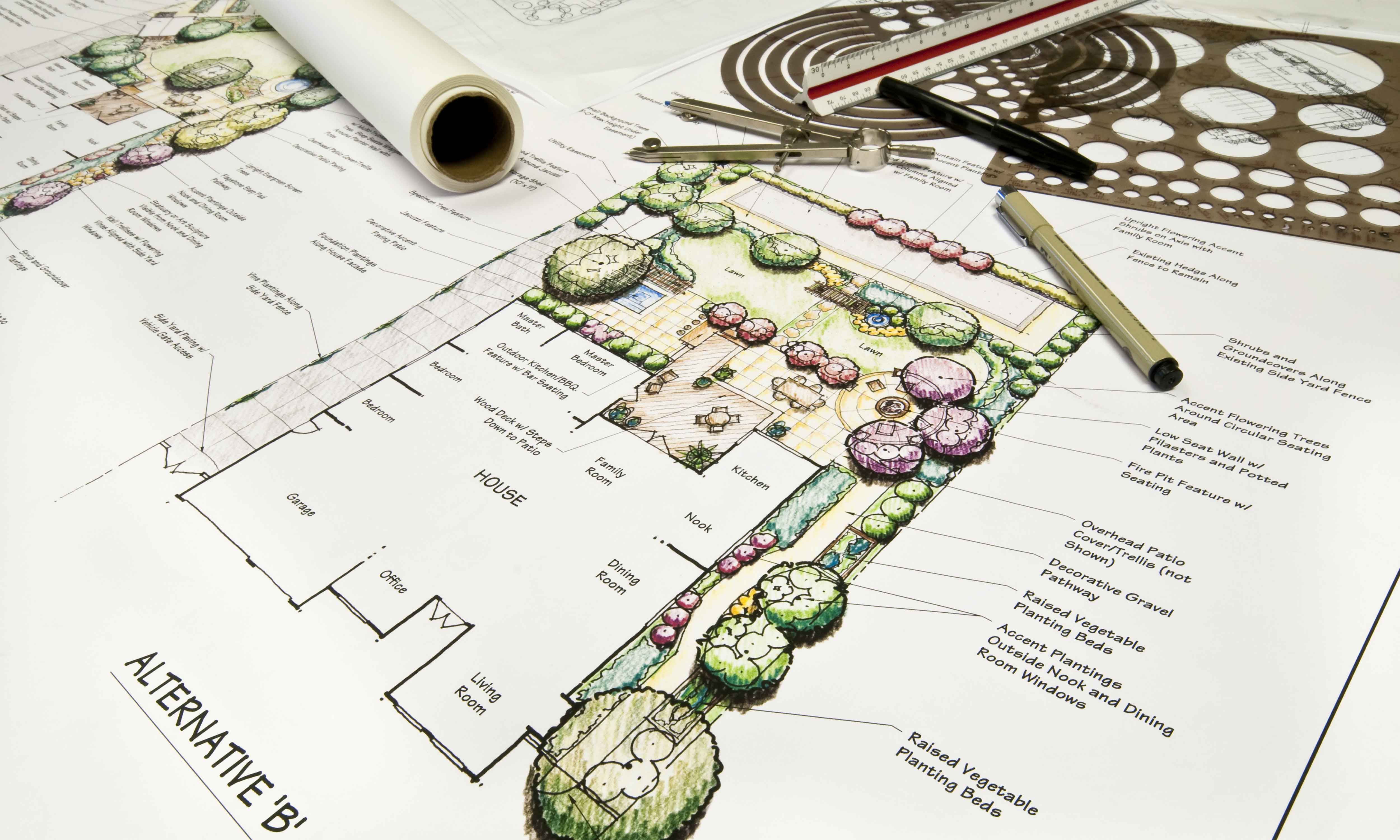
A sloping block can become one of the most interesting gardens on a Sydney property, but it is also one of the easiest landscapes to get wrong.
The problem is rarely the slope itself. The problem is treating a sloping site as if it were flat.
On a flat block, the design can often begin with layout: lawn, paving, planting, entertaining area, pool, path and screening. On a sloping block, the first question is different. The design must start with levels, drainage, access, soil stability and how the site will be built.
If those issues are not resolved early, the result is usually predictable: retaining walls in the wrong place, awkward stairs, unusable lawn, water running through garden beds, exposed views, expensive excavation changes, unstable planting zones or a backyard that looks designed but still feels difficult to use.
This guide explains how to approach landscape design for sloping blocks in Sydney, including terraces, retaining walls, drainage, access, planting, erosion control, and suburb-specific site conditions.
If you are planning a difficult site and want a tailored design, visit our Landscape Design Sydney page or explore our Landscape Plan Packages Sydney.

Quick Answer: How Do You Design a Sloping Block Landscape in Sydney?
A good sloping-block landscape design starts with accurate levels, drainage, and access. The site should be planned as a sequence of usable terraces, supported by retaining walls, steps, paths, planting zones, stormwater management and erosion control.
For Sydney homes, the design should consider:
- existing contours and finished levels
- cut and fill requirements
- retaining wall heights and locations
- surface and subsurface drainage
- safe pedestrian access
- stair rhythm and landing positions
- privacy between level changes
- soil depth for planting
- erosion control on exposed banks
- maintenance access
- council, engineering and stormwater requirements
- how each terrace will actually be used
The best sloping block designs do not simply flatten the land. They work with the slope, creating level areas where they are useful and planted transitions where full retaining would be unnecessary, expensive or visually heavy.
Sloping Blocks Are Not a Problem, But They Need a Different Design Process
Many Sydney homeowners see a sloping backyard as a limitation. In reality, slope can create privacy, outlook, drama, layered planting, better views and more interesting outdoor rooms.
The issue is that every design decision affects something else.
A retaining wall changes drainage. A new terrace changes privacy. A set of stairs changes circulation. Excavation changes soil stability. Raising one area may create overlooking into a neighbour's property. Planting a steep bank may reduce erosion, but only if the plants can establish properly.
That is why sloping blocks need a systems-based design process.
The designer has to think like a planner, horticulturist, drainage strategist and builder at the same time. A beautiful concept is not enough if it ignores where water goes, how people move, how retaining walls are built, or whether the selected plants can survive on the exposed bank.
At Dapple Landscape Design, sloping block design is approached through site conditions first: levels, aspect, soil, drainage, access, existing trees, views, privacy, bushfire exposure where relevant, and the practical construction sequence.

Start With Levels, Not Layout
The most important information on a sloping block is the level information.
Before deciding where the lawn, deck, path, pool, garden bed or retaining wall should go, you need to understand the existing ground levels and the relationship between:
- the house finished floor level
- alfresco or balcony levels
- boundary levels
- driveway level
- existing retaining walls
- neighbouring properties
- drainage pits and outlets
- easements
- existing trees
- proposed pool coping levels
- garage, side access and service areas
On sloping sites, even small level differences can change the design.
A 300mm rise might be managed with a step, a low edge or a planted transition. A 900mm change may require a retaining wall, balustrade consideration, drainage detail and a different access strategy. A two- or three-metre fall may require a full terrace sequence rather than a single large wall.
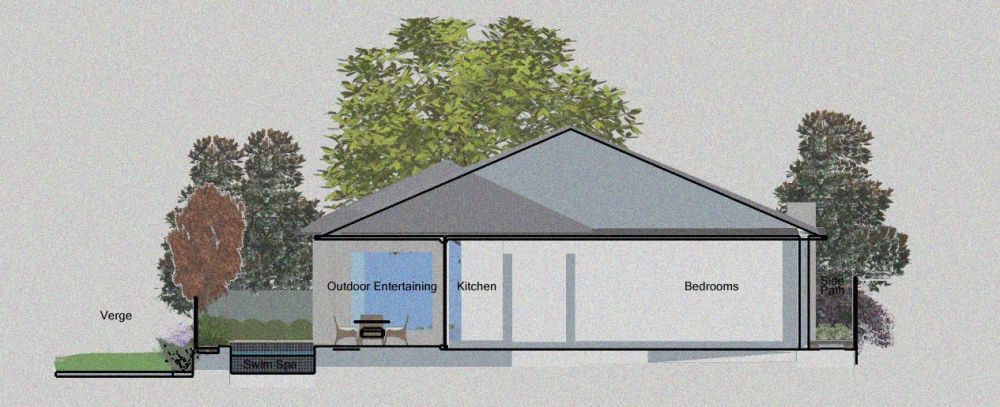
A common mistake is designing the garden from a plan view only. On a sloping block, the section is just as important as the plan. The design needs to show how one level meets another, where the ground is retained, where water escapes, where stairs land, and how each space feels when you stand in it.
A sloping-block landscape plan should not simply answer "Where does everything go?"
It should answer, "What level is each space, how do you move between them, and what holds the site together?"

Terraces, Retaining Walls and Cut-and-Fill Strategy
Terracing is often the most effective way to make a sloping backyard usable. It turns one difficult incline into a sequence of flatter outdoor rooms.
But terracing does not mean building as many retaining walls as possible.
Good terrace design is about deciding where level ground is genuinely valuable. A dining area needs a stable, level surface. A lawn for children needs enough flat space to be usable. A fire pit, pool, outdoor kitchen or seating area may need a clearly defined platform. A planted bank, however, may not need to be flattened at all.
On many Sydney blocks, the best result comes from combining:
- one or two main usable terraces
- lower retaining walls rather than one dominant wall
- planted batters where structural retaining is not necessary
- steps that follow the natural desire line
- walls that double as seating or planting edges
- drainage behind and below retaining structures
- planting that softens the level changes
Cut and fill needs careful thought. Excessive excavation can increase cost, create spoil removal issues, expose poor subsoil, affect tree roots and increase the need for retaining. Too much fill can create settlement risk, drainage problems and approval complications. The design should aim for intelligent level management, not simply forcing the site into a flat shape.
For related technical planning, see our Retaining Wall Design Sydney page.
Drainage Is the First Design Constraint on a Sloping Block
On a sloping block, water is not a minor detail. It is one of the main design drivers.
Water moves downhill across paving, lawns, garden beds, stairs, retaining walls and side passages. If the design does not control that movement, the landscape will show it quickly: scoured mulch, exposed roots, damp walls, slippery paving, wet lawn, leaning walls, sediment movement and planting failure.
A sloping-block drainage strategy needs to consider both surface and subsurface water.
Surface water is the visible runoff from rain, paving, roofs, lawns and hard surfaces. It needs to be directed safely through spoon drains, grated drains, swales, falls, pits, channels or controlled overflow paths.
Subsurface water is less visible but often more damaging. It can build up behind retaining walls, saturate planting beds, increase hydrostatic pressure, destabilise soil and create persistent damp zones. This is where ag lines, drainage aggregate, geotextile fabric, weep holes, free-draining backfill and discharge points become important.
A sloping garden should not rely on one drain at the bottom of the block. It needs drainage to be considered at each level change.
The design should ask:
- Where does water enter the site?
- Where does roof water discharge?
- Where does water concentrate during heavy rain?
- Can each terrace drain independently?
- Will retaining walls have appropriate back-of-wall drainage?
- Can runoff be slowed before it reaches the lowest point?
- Will water cross paths, steps or entertaining areas?
- Is the discharge point legal, stable and practical?
For more details, see our guide to Residential Landscape Drainage Sydney.
Erosion Control and Soil Stability
Erosion is a design issue, not just a maintenance issue.
On steep Sydney sites, exposed soil can move quickly during heavy rain, especially after excavation, turf removal, tree removal or construction traffic. Mulch can wash downslope. Newly planted tubes can be undermined. The lawn can thin out where water accelerates. Garden beds can slump if the soil profile is not stabilised.
Effective erosion control usually combines several strategies:
- reducing long uninterrupted slope lengths
- using terraces or contour planting
- placing plants across the slope rather than only at the top or bottom
- using groundcovers and fibrous-rooted plants to bind surface soil
- directing water into stable drainage paths
- avoiding bare soil during establishment
- using jute mesh, coir logs or erosion matting where needed
- selecting mulch that will not easily wash away
- protecting soil during construction
The goal is to slow water, hold soil and establish root systems before the slope is exposed to repeated storm events.
This is especially important in Blue Mountains suburbs such as Springwood, Blaxland, Glenbrook, Winmalee, Faulconbridge and Wentworth Falls, as well as steep Sydney areas such as Avalon, Bilgola, Newport, Seaforth, Castlecrag, Turramurra, Wahroonga, Como, Oatley and Engadine.

Access: Stairs, Paths, Ramps and Everyday Movement
A sloping garden fails when access feels like an afterthought.
The stairs may be too steep. The path may be in the wrong place. The lawn may be hard to reach. The bins, side gate, clothesline, pool equipment or lower garden may be inconvenient. Children and older family members may avoid parts of the yard because the movement feels awkward.
Good access design starts with desire lines. Where will people actually walk?
- From the kitchen to the alfresco.
- From the garage to the side gate.
- From the pool to the outdoor shower.
- From the deck to the lawn.
- From the upper terrace to the lower garden.
- From the house to the clothesline, bins or service area.
Stairs should be positioned where movement is natural, not wherever they fit after the retaining walls are drawn. Landings are important because they break long flights, create pause points and make the garden feel more comfortable. On larger slopes, stairs can also become part of the design language, with planting, lighting, stone, steel edging, timber, concrete or masonry used to turn circulation into a feature.
Ramps are not always practical on steep residential blocks because they require much more length than stairs. However, gentle paths, diagonal routes, step-and-ramp combinations or switchbacks can sometimes improve access where the site allows.
The key is to design access before finalising the walls and planting, not after.
Planting Design for Slopes, Banks and Retained Areas
Planting on a sloping block is not just about appearance. It affects erosion, soil stability, maintenance, privacy, shade, habitat, microclimate and how level changes are perceived.
A sloping site often needs several planting types working together:
- deep-rooted shrubs for slope stabilisation
- groundcovers to reduce surface erosion
- trees for canopy and scale
- strappy plants for texture and soil binding
- low planting near stairs and paths for visibility
- screening plants where level changes create overlooking
- drought-tolerant species for exposed banks
- shade-tolerant species under retained canopy or south-facing slopes
Plant spacing matters more on slopes. Plants that are too far apart leave exposed soil vulnerable to erosion. Plants that are too dense may create maintenance problems, block access or compete before they establish properly.
Soil depth is also critical. Retained planters, narrow terraces and raised beds may look generous on plan, but if the soil volume is too shallow, plant selection becomes limited. Small shrubs and groundcovers may work, but canopy trees or large screening plants may fail or require structural soil volumes that the site cannot provide.
This is where Dapple's horticultural knowledge is important. The studio's work includes planting plans, garden design, hardscape plans and landscape documentation, with Julian Saw's experience including work at the Royal Botanic Gardens and the University of Sydney. Dapple also provides Horticulturalist Sydney support for projects where plant performance and site suitability are central to the design.
Privacy on a Sloping Block
Privacy is more complicated on sloping sites because people are not all standing at the same level.
A neighbour upslope may overlook your pool, deck or lawn. A lower terrace may feel exposed from the house above. A raised outdoor dining area may look directly into a neighbouring bedroom. A boundary hedge that works at ground level may do nothing for an upper balcony sightline.
This is why privacy on a sloping block should be designed in section, not just plan view.
The design needs to identify the eye line. Once the point of view is understood, the solution can be much more accurate. Sometimes a small tree placed halfway down the slope works better than a tall hedge on the boundary. Sometimes a pergola, batten screen, level change, masonry wall or layered planting bed can solve the issue without overplanting the whole boundary.
In suburbs such as Mosman, Cremorne, Neutral Bay, Balmain, Birchgrove, Vaucluse, Dover Heights, Seaforth, and Castlecrag, privacy and views often need to be balanced carefully. The goal is not to block everything. The goal is to screen the uncomfortable sightlines while preserving light, outlook and spatial quality.
Designing Sloping Blocks Across Sydney's Different Landscapes
Sydney's sloping blocks are not all the same.
The right design response depends on geology, soil, exposure, rainfall, vegetation, bushfire risk, access and local development patterns.
Northern Beaches
Suburbs such as Avalon, Newport, Bilgola, Whale Beach, Collaroy, Dee Why, Balgowlah, Seaforth and Manly often involve steep driveways, coastal exposure, sandy soils, rock shelves, elevated views and difficult access. Landscape design here needs to consider salt-laden winds, drainage paths, retaining-wall access, privacy from uphill neighbours, and planting that can tolerate exposure.
A heavy, over-retained garden can feel wrong in these suburbs. The better approach is often a combination of terraces, native or coastal planting, stone, lightweight decks, planted batters and careful view framing.
North Shore and Upper North Shore
Mosman, Cremorne, Neutral Bay, Lane Cove, Hunters Hill, Lindfield, Roseville, Killara, Gordon, Pymble, Turramurra, Wahroonga and Hornsby often have established trees, sandstone, shade, older drainage patterns and steep rear gardens.
The challenge is often integrating new outdoor living areas without compromising the site's character. Existing canopy, tree protection zones, filtered light, root competition and privacy between neighbouring levels are major considerations.
A sloping North Shore garden may need a more refined level strategy: stone terraces, shaded planting, discreet drainage, steps that feel integrated into the garden, and careful management of existing trees.
Hills District and North West Sydney
Castle Hill, Baulkham Hills, Glenhaven, Dural, Kenthurst, Kellyville, Rouse Hill, and surrounding suburbs often have larger family blocks, greater level changes, pools, lawns, and outdoor entertaining requirements.
Here, the key question is often how to create usable family zones without overbuilding the slope. Retaining walls may be necessary, but the best design usually avoids making the entire backyard a single hard-edged platform. Terraced lawns, pool zones, outdoor rooms, planting banks, and clear access routes often produce better long-term results.
Eastern Suburbs
Vaucluse, Dover Heights, Bronte, Coogee, Clovelly, Randwick and Bellevue Hill may involve steep blocks, coastal winds, views, privacy pressure and high-value outdoor living expectations.
These sites often require careful balancing of outlook and screening. Terraces should feel intentional, not forced. Materials need to be handled to withstand exposure. Planting needs to tolerate wind, salt and limited soil depth in retained or built-up areas.
Inner West
Balmain, Birchgrove, Drummoyne, Lilyfield, Annandale, Glebe and Rozelle often have narrow blocks, older retaining walls, tight side access, small courtyards and level changes between the street, house and rear garden.
The design challenge is precision. There may not be room for sweeping terraces or wide garden beds. Built-in seating, compact stairs, raised planters, small trees, narrow screening and clever drainage can make a small sloping block feel deliberate rather than compromised.
Sutherland Shire and Southern Sydney
Gymea, Kirrawee, Como, Oyster Bay, Engadine, Jannali and Oatley often include sloping backyards, bushland edges, rock shelves and family outdoor living needs.
Landscape design here may need to combine retaining, native planting, drainage, bushfire awareness, privacy and durable outdoor areas. Where the site backs onto bushland or drainage corridors, runoff and planting choices need particular care.
Western Sydney and Blue Mountains
Springwood, Glenbrook, Blaxland, Winmalee, Faulconbridge, Wentworth Falls, Penrith, Camden, Hawkesbury, and surrounding areas often involve steeper level changes, bushfire considerations, cooler Blue Mountains microclimates, exposed slopes, and larger blocks.
The design response needs to account for slope stability, drainage, bushfire-sensitive planting, frost in some areas, and construction access. For more Blue Mountains-specific ideas, see our landscape designer's guide to Backyard Landscape Design Ideas for Sloped Blocks in the Blue Mountains.
Retaining Wall Design: What Homeowners Often Miss
Retaining walls are not just visual features. They are structural elements that hold soil, manage level changes and affect drainage.
The common mistake is choosing the wall material first: sandstone, concrete block, timber, blockwork, gabion, formed concrete or steel. Material matters, but it is not the first decision.
The first decisions are:
- what height does the wall need to retain
- what load is above the wall
- where the water behind the wall will go
- whether the wall is near a boundary, easement, sewer or water main
- whether engineering or approval is needed
- how the wall connects to steps, paving and planting
- whether one tall wall or several lower walls will produce a better outcome
- how the wall will be accessed for construction
In NSW, some small retaining walls may not require council approval if they meet specific conditions, including height, distance from boundaries and separation from other walls. However, approval requirements depend on site-specific details, so retaining walls should be checked early rather than assumed exempt.
The best walls feel integrated into the garden. They may double as seating, define terraces, hold planting beds, frame steps or support outdoor living areas. Poorly placed walls make a garden feel like a civil engineering project. Well-placed walls make a difficult slope feel intentional.
Materials for Sloping Blocks
Material selection on a sloping block should be based on structure, access, drainage, maintenance and visual weight.
Sandstone can suit Sydney sites where rock, native planting or established gardens are part of the character.
Concrete block and masonry systems can provide strength and clean geometry.
Timber may suit smaller, informal garden walls but has a shorter lifespan and should be used carefully where moisture, termites or structural loads are a concern.
Gabion walls can provide texture and drainage capacity, but they need enough space and the right setting.
Formed concrete can work in modern gardens where clean lines and structural clarity are required.
For paths and steps, material choice should consider slip resistance, drainage, heat, maintenance and how the surface performs in shaded or damp areas. A beautiful finish that becomes slippery under leaf litter or moss may not be suitable for a shaded North Shore or Blue Mountains slope.
On sloping blocks, materials need to be buildable. Tight access, crane requirements, spoil removal, hand excavation and delivery constraints may influence what is realistic.

Lighting on Sloping Blocks
Lighting is especially important on sloping sites because changes in level create trip hazards and dark transition zones.
Good lighting is not about flooding the entire backyard. It should guide movement and reveal the structure of the garden.
Useful lighting locations include:
- stair treads and risers
- landings
- path edges
- retaining wall faces
- level transitions
- entry points
- pool access routes
- feature trees
- outdoor living terraces
On a sloping block, lighting can also make the garden feel larger at night. Instead of one dark drop beyond the deck, the eye can read layers: foreground planting, steps, lower terrace, trees and boundary planting.
Lighting should be planned early because walls, steps, conduits, transformers and planting positions affect how easily it can be installed.
Maintenance Access on a Sloping Block
A sloping garden may look good upon completion but may fail if it cannot be maintained.
Maintenance access should be designed into the plan. Gardeners need to reach hedges, banks, lawn, drainage pits, retaining wall outlets, pumps, tanks, pool equipment, bins and planted terraces. If access is awkward, maintenance becomes inconsistent and the garden declines.
A steep lawn is one of the most common maintenance mistakes. Turf on a steep slope can be difficult to mow, prone to erosion and uncomfortable to use. In many cases, a planted bank, groundcover layer, terrace or deck is more practical than forcing lawn onto a gradient that will never function well.
Planting should also be selected with maintenance in mind. A fast-growing hedge on a steep bank can quickly create privacy, but it can become expensive and difficult to prune. A low, layered planting scheme with better mature sizing may perform better over time.
Common Mistakes on Sloping Sydney Blocks
The most common mistakes are planning mistakes, not style mistakes.
They include:
- designing from a plan view without enough level information
- building one large retaining wall, where several smaller terraces would work better
- treating drainage as a construction detail instead of a design constraint
- placing stairs where they fit rather than where people naturally move
- forcing lawn onto a slope too steep to use or maintain
- selecting plants without considering soil depth, erosion or exposure
- failing to coordinate retaining walls with access and drainage
- ignoring privacy created by level changes
- underestimating construction access and spoil removal
- placing heavy planting too close to walls without considering root growth and maintenance
- not allowing space behind retaining walls for drainage
- designing a beautiful lower terrace that is inconvenient to reach
- forgetting lighting on stairs and level transitions
On a sloping block, every one of these mistakes can become expensive because levels, walls and drainage are harder to change once built.
Why Dapple's Approach Suits Sloping Blocks
Dapple Landscape Design prepares landscape plans for Sydney homes where site conditions, council documentation, planting performance and outdoor living all need to work together.
Sloping blocks suit this approach because they require more than a visual design. They need practical thinking around levels, terraces, retaining walls, access, drainage, planting and buildability.
Dapple is led by Julian Saw, a qualified landscape designer with over a decade of experience. His background includes work at the Royal Botanic Gardens and the University of Sydney, giving the design process a strong horticultural foundation. That matters on sloping sites, where plant selection affects erosion control, soil stability, privacy, shade and maintenance.
Dapple's work includes DA landscape plans, planting plans, hardscape plans, 3D modelling, construction details and landscape specifications for residential, commercial and strata projects. The studio services Sydney, the Blue Mountains and surrounding regions, including Camden, Penrith, Parramatta, Liverpool, Hawkesbury, Blacktown, The Hills Shire, Campbelltown and the wider Sydney metro area.
For sloping blocks, this combination of design, horticulture and documentation helps create gardens that are not only attractive, but easier to build, drain, plant and maintain.
For related services, see our Garden Design Sydney, Residential Landscaping Sydney and Sustainable Landscaping Sydney pages.
Sloping Block Landscape Design Checklist
Before finalising a sloping block landscape design, check:
- Are existing and proposed levels clearly understood?
- Has the site been designed in section, not just plan view?
- Where does water enter, move through and leave the site?
- Are retaining walls positioned for both structure and usability?
- Is one large wall being used where several smaller terraces would work better?
- Can each terrace drain properly?
- Are stairs positioned along natural movement lines?
- Are landings included where long stair runs would feel uncomfortable?
- Is the proposed lawn actually usable and maintainable?
- Are planting beds deep enough for the selected plants?
- Will planting help stabilise banks and reduce erosion?
- Are privacy issues being assessed from the correct eye level?
- Has construction access been considered?
- Are existing trees, roots and canopy impacts understood?
- Will the garden still be practical after plants mature?
- Does the design account for the specific suburb, soil, exposure and microclimate?
This is the difference between a sloping garden that only looks good on a concept plan and one that performs in daily use.
Dapple Landscape Design Experience
Dapple Landscape Design is based in Springwood, NSW, and serves Sydney, the Blue Mountains, and surrounding regions. The studio is led by Julian Saw, a qualified landscape designer with over a decade of experience.
Dapple prepares DA landscape plans, planting plans, hardscape plans, 3D modelling, construction details and landscape specifications for residential, commercial and strata properties.
Business details:
Dapple Landscape Design Pty Ltd
Ellison Road, Springwood NSW 2777
Phone: (02) 4751 1361
ABN: 29 619 726 948
Instagram: @dapple_landscape_design
FAQs About Landscape Design for Sloping Blocks in Sydney
How do you landscape a sloping block in Sydney?
A sloping block should be designed around levels, drainage and access first. The best approach is usually to create a sequence of usable terraces, supported by retaining walls, steps, planted banks, drainage systems and site-suitable planting.
Is it better to terrace a sloping backyard?
Terracing is often the best way to make a sloping backyard usable, but not every part of the slope needs to be flattened. The strongest designs create level areas where they are useful, such as dining, lawn, pool or seating zones, while using planted banks or softer transitions where full retaining is unnecessary.
Do retaining walls need council approval in Sydney?
Some small retaining walls may be exempt if they meet specific NSW conditions, including height, setback from boundaries and separation from other retaining walls. However, requirements depend on the wall height, location, load, easements, drainage and local council rules. It is best to check early before designing or building.
Why is drainage so important on a sloping block?
Drainage is critical because water moves downhill through the site. Without proper surface and subsurface drainage, sloping gardens can suffer from erosion, wet paving, unstable retaining walls, waterlogged planting beds, sediment movement and damage to lower parts of the property.
What plants work best on sloping blocks?
The best plants for sloping blocks are usually those that help stabilise soil, tolerate the site's sun and moisture conditions, and suit the available soil depth. Groundcovers, strappy plants, shrubs and selected trees can all be used, depending on the slope, exposure, soil and maintenance access.
Can you put A lawn on a sloping block?
Yes, but only where the gradient is practical. A steep lawn can be difficult to mow, uncomfortable to use and prone to erosion. On steeper areas, terracing, groundcovers, planted banks, or steps may be more practical than forcing turf onto the slope.
What is the biggest mistake with sloping block landscaping?
The biggest mistake is designing the layout before resolving levels and drainage. On sloping sites, the success of the whole garden depends on how terraces, retaining walls, paths, stairs, planting and stormwater movement work together.
Are sloping blocks more expensive to landscape?
They can be more expensive because they often require retaining walls, excavation, drainage systems, stairs, engineering input, difficult access and more careful construction staging. Good design helps control those costs by resolving the level strategy before work begins.
How do you create privacy on a sloping block?
Privacy on a sloping block should be designed with sightlines in mind. A hedge on the boundary may not screen an upper window or balcony. Small trees, layered planting, screens, pergolas, level changes and strategic planting positions can often provide better privacy than simply planting along the fence.
When should I get a landscape designer involved?
For a sloping block, a landscape designer should be involved before major excavation, retaining, pool work, paving or planting decisions are locked in. Early design helps coordinate levels, drainage, access, terraces, planting and construction requirements.
Speak With Dapple About Your Sloping Block Landscape Design
If your Sydney property has a steep backyard, awkward levels, poor drainage, difficult access or unusable outdoor space, Dapple Landscape Design can help you plan the site properly before costly work begins.
We consider the full sloping-site system: terraces, retaining walls, drainage, access, planting, privacy, soil stability, outdoor living, construction details and long-term maintenance.
Call us on 1300 DAPPLE (1300 327 753) or send us a message below:
For a tailored sloping block landscape design, contact Julian today on 1300 DAPPLE (1300 327 753) or visit the Landscape Design Sydney page.