By Dapple Landscape Design | Updated August 2026
To make a small garden look bigger, reduce visual interruptions, extend sightlines, soften some boundaries, use fewer materials and give the eye one strong place to focus.
The surprising part is that you do not necessarily need smaller paving, smaller plants or less greenery. In many compact gardens, using too many small elements actually makes the space feel busier and easier to measure.
Good small garden design is really about controlling what you see, where you look and how you move through the space.
Quick answer
The biggest gains usually come from simplifying the layout, preserving some empty space, creating longer views, screening only where privacy is actually required, and selecting plants for their mature size rather than their size at the nursery.
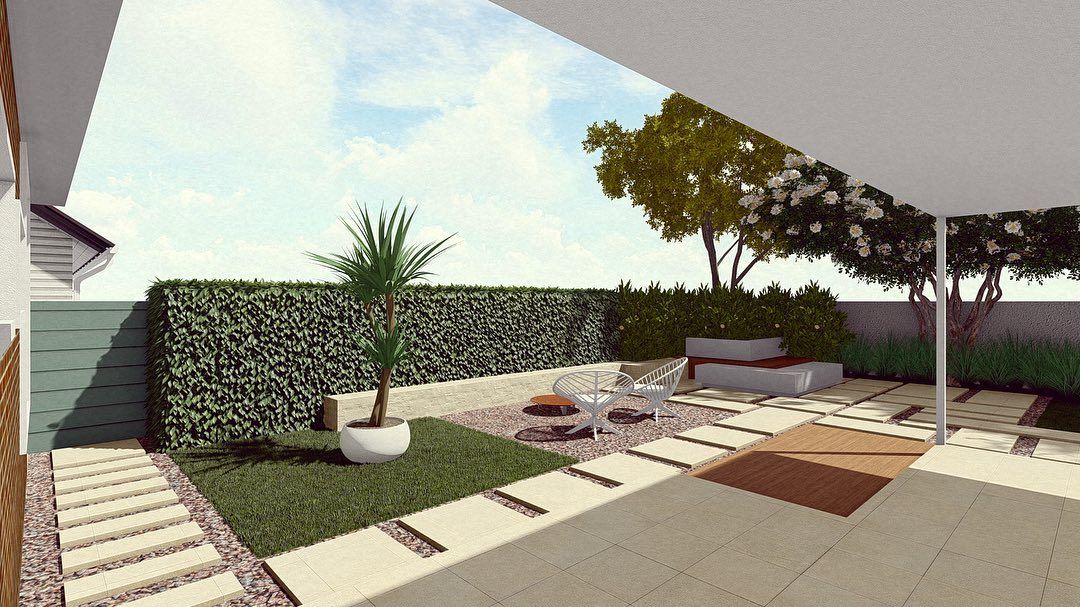
Clear sightlines, coherent planting and controlled boundaries can make a compact garden feel more generous.
In this guide
Why Does a Small Garden Feel Small?
Physical dimensions are only part of the problem.
A garden often feels cramped because the eye encounters too many interruptions: a visible back fence, several paving patterns, scattered pots, oversized furniture, competing focal points or planting that has outgrown its position.
Each interruption makes the boundaries and scale of the garden easier to understand.
Conversely, a well-planned compact garden can feel larger because the eye moves through it smoothly rather than repeatedly stopping.
The Three-View Test: Start Here Before Changing Anything
Before buying plants or changing paving, assess the garden from the places where it is actually experienced.
1. Interior View
Stand at the kitchen, dining or living-room window.
What immediately stops your eye?
2. Entry View
Look at what is revealed when someone first enters the garden.
Where does the eye go first?
3. Occupied View
Sit where you would normally dine, entertain or relax.
What dominates the view?
Photograph all three views. A fence, shed, blank wall, oversized setting or exposed service area that dominates two or three photographs is usually more important to resolve than an isolated decorative detail.
1. Give the Eye Somewhere Better to Go
If the rear fence is the strongest feature visible from the house, your eye immediately understands where the garden ends.
A more effective composition creates a deliberate focal point: perhaps a feature tree, sculptural plant, seat, artwork, water element or richly planted area.
The position matters more than the object itself. Place the focal point on an important sightline—or use it deliberately to draw attention away from an unattractive boundary.
Dapple designer principle: design important views from inside the home as carefully as the areas where you physically sit in the garden.
2. Don't Reveal Every Boundary at Once
There is a useful contradiction in small garden design: clearly seeing every edge can make the space feel smaller, while partially obscuring a boundary creates uncertainty about exactly where the garden finishes.
You can achieve this without constructing walls or creating tiny artificial "rooms". Instead:
- Allow planting to overlap parts of a fence.
- Use a tree canopy to interrupt a distant boundary.
- Soften corners with layered planting.
- Angle a path or paving line away from the most obvious destination.
- Create a focal point that is partly framed rather than completely exposed.
The objective is controlled concealment—not clutter.
3. Protect Some Negative Space
A common mistake is assuming every square metre must do something.
A barbecue, dining setting, lounge, lawn, shed, several pots and multiple feature plants may all be attractive individually. Combined, they can make a small garden visually exhausting.
Try the negative-space test
From the main viewing position, can your eye rest anywhere without encountering furniture, ornament, a material change or a competing feature? If not, removing something may improve the garden more than adding another element.
A lush garden can still feel spacious. The difference is that planting should read as coherent masses and layers rather than dozens of unrelated objects.
4. Use Fewer Materials, More Confidently
Every paving border, texture change and contrasting material introduces another visual line.
In a compact landscape, continuity usually works harder than variety.
Consider using one primary paving material, aligning joints with doors or architectural lines, repeating colours already present in the house and limiting unnecessary changes between paving, gravel, decking and edging.
And don't assume everything needs to be small. Generously proportioned paving units can appear calmer than many small pavers because there are fewer joints dividing the surface.
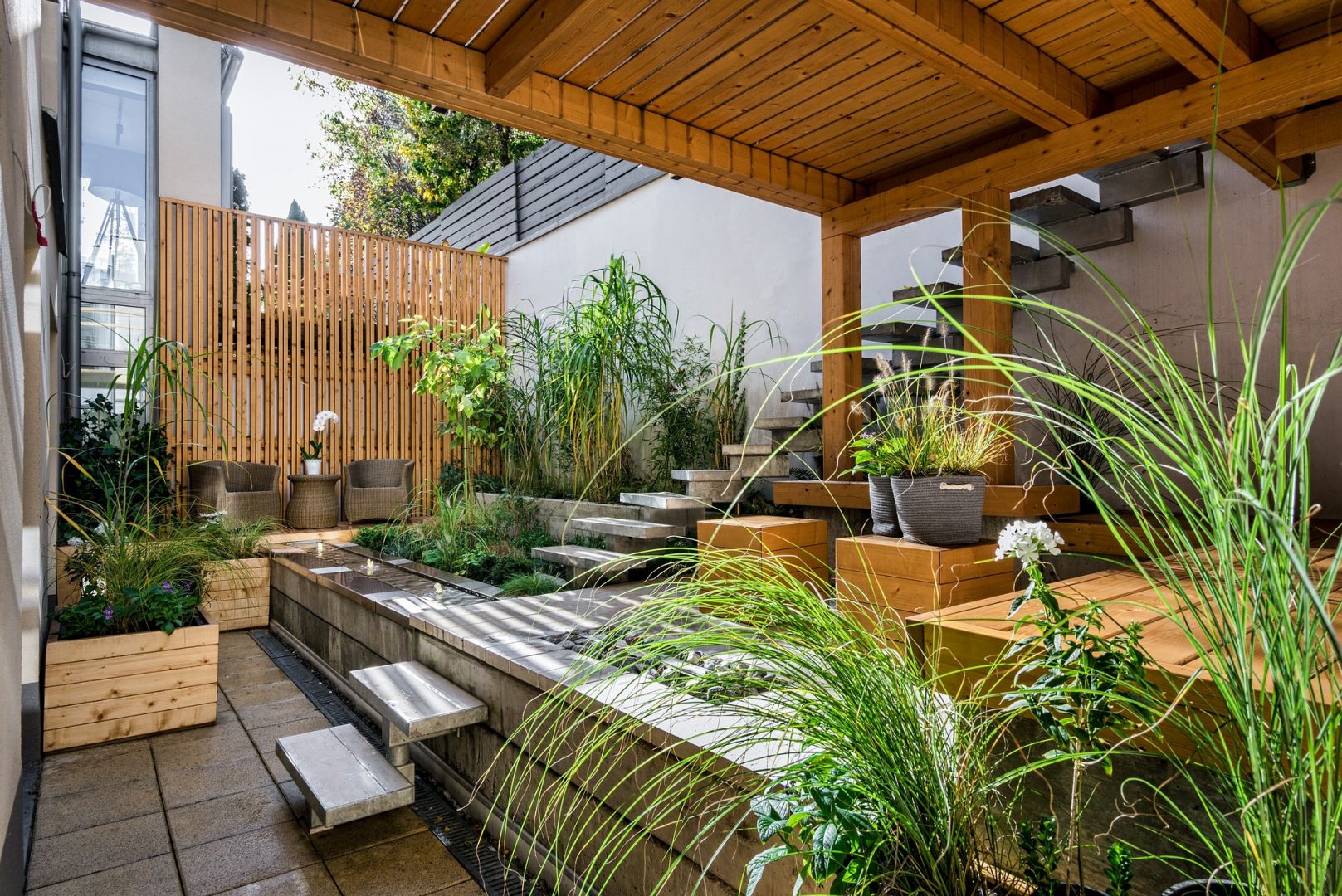
Coordinating the garden with the architecture helps the outdoor space feel like an extension of the home.
5. Don't Be Afraid of One or Two Larger Plants
Filling a small garden exclusively with tiny plants can make it feel fragmented.
One appropriately positioned small tree or structural shrub may provide canopy, shade, privacy and vertical scale more successfully than many small specimens.
Think mature size, not nursery size. Before selecting a plant, consider its eventual height and width, root space, growth habit, maintenance requirements, sunlight, soil, drainage and proximity to structures.
A plant that looks perfectly proportioned in a nursery pot may become the dominant feature of a courtyard within several years.
Explore Dapple's Plant Finder to compare plants for different landscape conditions and design uses.
6. Solve Privacy as a Sightline Problem
Privacy is one of the easiest ways to accidentally make a small Sydney garden feel even smaller.
A dense hedge or solid screen around every boundary may stop overlooking, but it can also reduce daylight, restrict airflow and create a stronger sense of enclosure.
Instead, identify exactly where the unwanted view comes from.
Instead of...
Automatically planting a dense hedge around the entire boundary.
Consider...
Screening the exact window, angle or seating area that creates the privacy problem.
An upper-storey window may be screened with one well-positioned tree. A narrow side view might need upright planting or a climber. A seating area may require only a short section of permeable screening.
Screen the view that needs screening—not automatically the whole boundary.
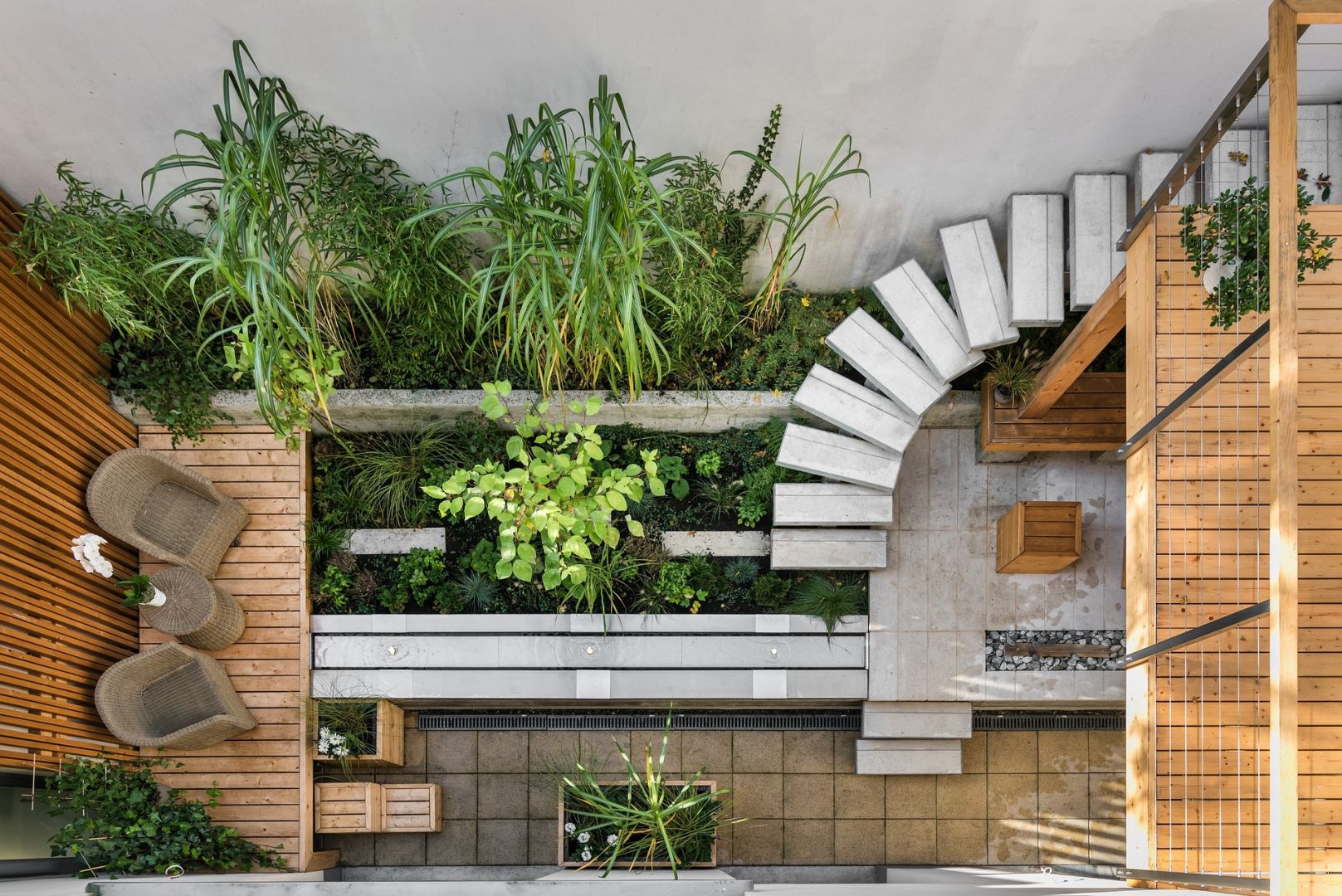
Targeted screening can provide privacy without unnecessarily enclosing the entire garden.
7. Use the Vertical Dimension Selectively
Climbers, narrow planting beds, espaliered plants and vertical greenery can add landscape depth without consuming much floor area.
But covering every fence with pots, shelves and vertical gardens simply moves the clutter from the ground onto the walls.
Use vertical planting where it solves a specific problem: softening a wall, providing targeted privacy, framing a focal point or adding greenery where ground space is genuinely limited.
8. Measure Furniture Before Designing Around It
Furniture is often chosen after the landscape. In a small garden it should be part of the layout from the beginning.
Mark the full dimensions of the proposed furniture on the ground, including the room required to pull chairs back and circulate around them.
Built-in seating can be particularly efficient because a retaining wall or planter edge may perform two functions.
Prioritise comfort over quantity. A properly proportioned dining area is generally more useful than squeezing undersized dining, lounge and lawn zones into the same footprint.
What Makes Small Sydney Gardens Different?
Compact gardens across Sydney can combine several constraints at once.
Terraces can combine restricted construction access with shade between closely spaced buildings.
Upper-storey overlooking may need to be resolved without sacrificing useful winter sunlight.
Masonry and paving can generate significant reflected summer heat in enclosed spaces.
Heavily paved compact gardens may also require careful consideration of drainage and stormwater movement.
That is why copying an attractive small-garden image without understanding the site can produce disappointing results. The layout, screening, planting and materials should respond to the property's actual orientation, architecture and microclimate.
Plant selection is equally site-specific. Dapple's guide to planting for Sydney weather explains how local climate conditions influence what will perform successfully in the landscape.
Australian design guidance: The Australian Government's Your Home landscaping and garden design guide also recommends considering landscapes from both inside and outside the home, and using vegetation to create shade, frame views and provide privacy.
For particularly constrained properties, see Dapple's guide to landscape design for small and narrow Sydney blocks or learn more about courtyard garden design.
Small-Garden Problems and Better Design Responses
| Problem | Why It Feels Smaller | Better Response |
|---|---|---|
| Exposed rear fence | Clearly defines the end of the garden | Layer planting or create a focal point |
| Many paving types | Creates multiple visual divisions | Use a restrained material palette |
| Dense boundary screening | Reduces light and increases enclosure | Screen specific overlooking angles |
| Many small pots | Creates repeated visual clutter | Use larger coherent planting areas |
| Oversized furniture | Interrupts circulation | Measure circulation before selection |
Design the View From Inside the House
One of the most overlooked opportunities in a small garden is the view from indoors.
A compact courtyard may only be physically occupied for part of the day, but it can remain visible from the kitchen, living room or dining area throughout the year.
Positioning a feature tree or layered planting within that view, continuing architectural lines into the landscape and keeping service areas away from important windows can make the garden improve the experience of the house itself.
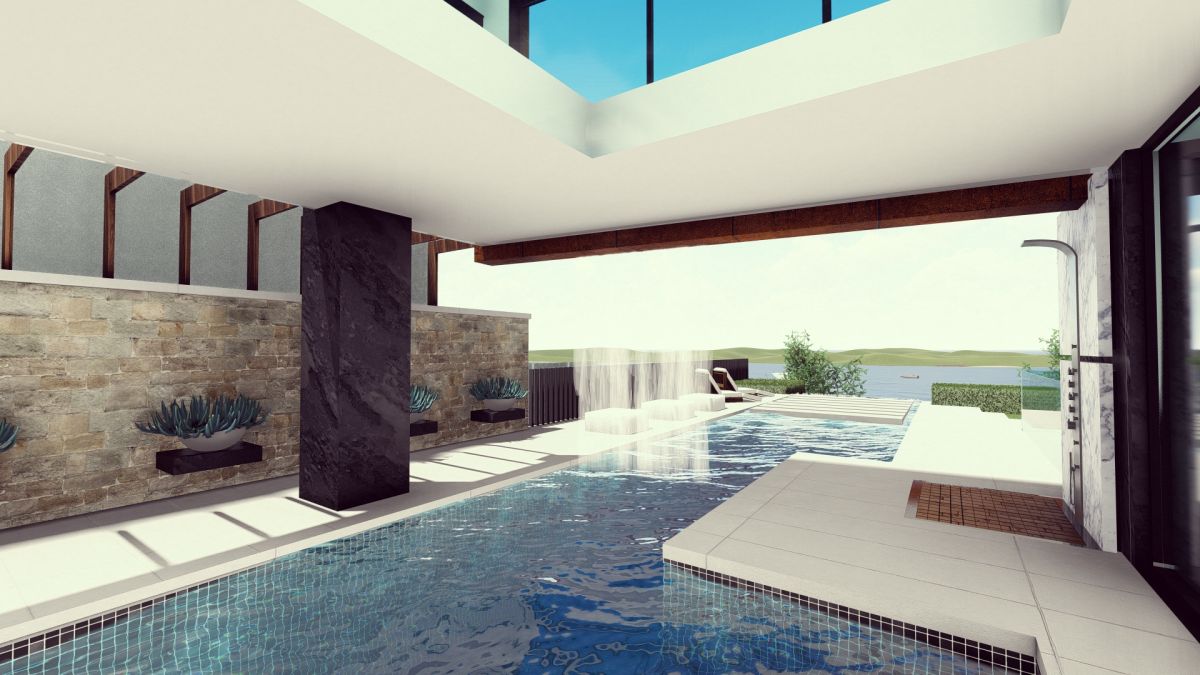
Testing scale, planting and circulation together helps prevent a compact landscape from becoming overcrowded.
Small Garden Design Is Really an Exercise in Editing
The goal is not to discover clever ways to squeeze everything into a small space.
It is deciding what deserves space in the first place.
Sometimes the biggest improvement is removing two materials. Sometimes it is relocating a tree so it changes the view from the kitchen. Sometimes it is screening one neighbouring window rather than enclosing the entire garden.
Many of these issues are also covered in Dapple's guide to common garden design mistakes.
Dapple Landscape Design has designed residential landscapes across Sydney and the Blue Mountains since 2013. Led by principal designer Julian Saw, Dapple combines spatial planning, horticultural knowledge, landscape documentation and 3D visualisation to resolve compact and complex residential sites.
You can view completed Dapple landscape projects, explore our backyard landscape design services or compare our landscape plan packages.
Frequently Asked Questions
What colours make a small garden look bigger?
Do large plants make a small garden look smaller?
Should a small garden have a lawn?
How can I create privacy without making my garden feel enclosed?
Planning a Small Sydney Garden?
A compact landscape should feel deliberate, not crowded. Dapple can develop a garden plan around your property's dimensions, architecture, privacy, light, planting conditions and the way you want to use the space.
Explore Small Garden Design Call 1300 DAPPLE
1300 327 753